New Arrival!! Check Out Our Store To Order Your Copy of "Rest, Revive, Reset Now!
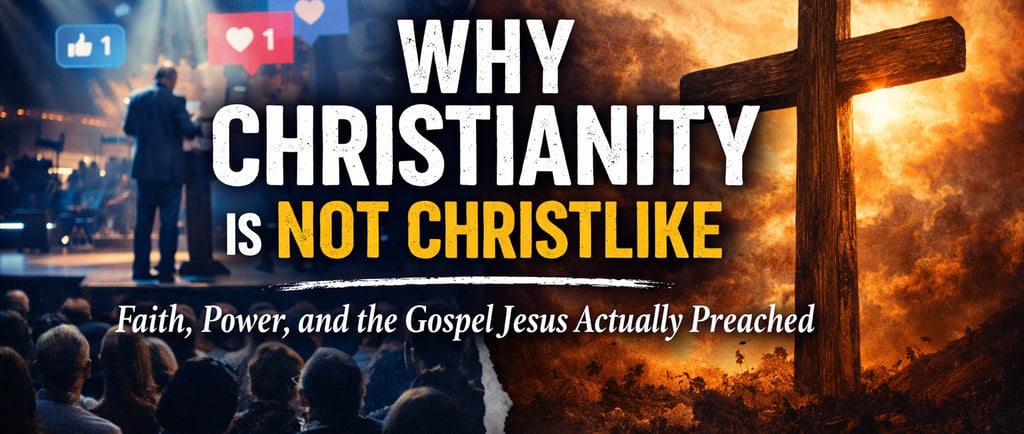
Why Christianity Is Not Christ Like
Why Christianity Is Not Christ Like and How The Religion Became a Cover-Up for Sin, Power, and Cultural Control—From Western Empires to Black Churches and the Global Social Media Age.
Dr. Makeda Ansah
1/8/20266 min read
Dear Fellow Citizens of Earth, Believers, and Saints:
Are You Confused About God, The Church, Your Faith, How To Live Life Without Fear? If so, you are in the right place. What is happening in the world is no accident, and don't listen to any pastor or church goer who says there no guide book, that is a lie! There is a handbook and solution for everything.
Truth, and answers to the world's problems are found in God's word!!
Please read the Bible prayerfully, humbly and with pray for discernment. Ask and you shall receive, seek and you will find, knock and the door will be opened (Matthew 7:7-8).
Let Us Now Examine Why "Christianity Is Not Christlike: How Christianity Became a Cover for Sin, Power, and Cultural Control—From Western Empires to Black Churches and the Global Social Media Age"
The Disturbing Gap Between Christ and Christianity
Christianity, as practiced in much of the West, bears a troubling resemblance to culture, empire, capitalism, patriarchy, nationalism, and celebrity, yet often bears little resemblance to Jesus Christ Himself.
This is not an accusation made lightly. It is an observation rooted in Scripture, history, lived experience, and the visible fruit of modern Christianity—particularly as expressed in Western churches, Black churches shaped by survival theology, and now, globally exported through social media platforms.
Jesus warned us plainly:
“You will know them by their fruits.” — Matthew 7:16 (ESV)
If the fruit of Western Christianity includes exploitation, abuse cover-ups, racial hierarchy, misogyny, greed, spiritual manipulation, and moral compromise—then we must ask a hard theological question:
How did a faith centered on Christ become so un-Christlike?
1. Christ vs. Christianity: A Necessary Distinction
Jesus did not come to create an institution obsessed with power.
He came to reconcile humanity back to God.
“The Son of Man came not to be served but to serve, and to give his life as a ransom for many.” — Mark 10:45
Yet Western Christianity has often elevated:
Authority over accountability
Power over humility
Image over integrity
Tradition over truth
Christianity became something Jesus never modeled:
A political weapon
A social control mechanism
A moral shield for unrepentant sin
This is not a rejection of Christ—it is a rejection of counterfeit Christianity.
Christianity in the West is facing not merely a crisis of relevance, but a crisis of credibility. While churches grow in visibility, influence, and digital reach, the moral and spiritual authority of Christianity continues to erode. This erosion is not due to persecution or secular hostility, as some claim, but to a widening chasm between Jesus Christ and the version of Christianity practiced, defended, and exported by Western institutions.
Jesus warned that religious structures could become antithetical to God’s purposes:
“This people honors me with their lips, but their heart is far from me.”
— Matthew 15:8 (ESV)
The question before us is not whether Christianity is biblical in name, but whether it is Christlike in substance.
2. How Christianity or The Christ Led Church,Was Co-Opted by Empires Over Time
Historically, Christianity was radically subversive. Early Christians were persecuted precisely because they refused allegiance to empire.
That changed in the 4th century, when Christianity was institutionalized under Roman imperial authority.
Once Christianity aligned with empire:
Obedience replaced discipleship
Hierarchy replaced servanthood
Orthodoxy became enforced, not lived
Faith became a tool to maintain order, not to transform hearts.
This pattern repeated itself in:
European colonialism
The transatlantic slave trade
Missionary movements tied to imperial expansion
Enslaved Africans were introduced to a selective Christianity—one that emphasized submission but ignored liberation.
“Slaves, obey your earthly masters…” was preached
“Let my people go” was silenced
This was not Christ.
This was Christianity weaponized.
Further, Jesus did not establish a religion aligned with empire, nationalism, or economic dominance. He announced a Kingdom not of this world (John 18:36), marked by humility, repentance, justice, and sacrificial love.
His ministry consistently:
Challenged religious elites
Centered the poor, women, children, and the marginalized
Condemned hypocrisy more than immorality
Exposed power cloaked in piety
“Woe to you, scribes and Pharisees, hypocrites!”
— Matthew 23
Christ’s kingdom ethic was fundamentally anti-domination.
From Persecuted Faith to Imperial Religion
The turning point in Christian history occurred in the 4th century, when Christianity transitioned from a persecuted movement to a state-sponsored religion under Emperor Constantine. While this shift offered legal protection, it also altered Christianity’s character.
Church historian Eusebius celebrated this alliance, but later theologians would question its cost. The church gained power, but lost its prophetic edge.
From this moment forward:
Orthodoxy was enforced by law
Dissent was criminalized
Christianity became aligned with state interests
This fusion of church and empire laid the groundwork for future abuses.
Christianity and Colonial Violence
European colonialism carried the cross alongside the sword. Christianity was often used to justify:
Indigenous dispossession
Racial hierarchies
Enslavement of African
Theologians like Bartolomé de las Casas protested these abuses, but they were exceptions, not the rule.
Enslaved Africans were given a truncated gospel:
Obedience without liberation
Submission without dignity
Heaven without justice
“Christianity became a religion of the oppressor rather than the oppressed.”
— James H. Cone, The Cross and the Lynching Tree
3. The Black Church: Born Out of Survival, Often Silence, and Drenched In Complicity
The Black church emerged as a place of refuge, resistance, and community. It preserved dignity when society denied humanity.
But survival theology, while necessary at one time, eventually created limitations.
In many Black churches:
Pain is spiritualized instead of healed
Abuse is prayed away instead of confronted
Leaders are protected more than congregants
Women carry churches but are denied authority
Jesus consistently confronted religious leaders who used God to protect themselves:
“You shut the kingdom of heaven in people’s faces.” — Matthew 23:13
When churches prioritize:
Respectability over repentance
Loyalty over truth
Unity over justice
They stop looking like Christ and start resembling the systems that oppressed them.
4. Christianity as a Cover for Sin
One of the most dangerous distortions of Western Christianity is its ability to cloak sin in spiritual language.
Examples include:
Sexual abuse hidden behind “grace”
Financial exploitation framed as “faith”
Misogyny justified by “biblical order”
Racism dismissed as “politics”
Scripture is clear:
“Shall we continue in sin that grace may abound? By no means!” — Romans 6:1–2
Grace was never permission to remain unrepentant.
Jesus forgave repentant sinners, but He rebuked hypocritical leaders without hesitation.
5. The Rise of Social Media Christianity
Social media has not created theological error—it has accelerated it.
Algorithms reward:
Certainty over humility
Influence over integrity
Visibility over virtue
According to Pew Research (2023), religious content engagement has increased online, while church trust has declined—a troubling paradox.
Paul foresaw this dynamic:
“Having the appearance of godliness, but denying its power.”
— 2 Timothy 3:5
What was once confined to pulpits is now globalized through platforms.
Social media has:
Amplified untrained theology
Rewarded charisma over character
Monetized revelation
Turned faith into performance
Christian influencers now:
Build platforms without accountability
Teach without discipleship
Speak authoritatively without theological grounding
The algorithm favors:
Controversy over correction
Confidence over competence
Aesthetic faith over obedient faith
Paul warned of this exact phenomenon:
“For the time is coming when people will not endure sound teaching…” — 2 Timothy 4:3
Christianity becomes a brand.
Christ becomes optional. When proposed vessel of the Most High become a distraction!
6. Why This Matters Globally
Western Christianity is exported—through missions, media, podcasts, and viral clips.
What the world receives is often:
American individualism
Prosperity ideology
Patriarchal authority
Anti-intellectual faith
Instead of the gospel of the Kingdom:
“Your kingdom come, your will be done, on earth as it is in heaven.” — Matthew 6:10
The result?
Confusion
Spiritual abuse
Cultural Christianity without Christ
7. The Christlike Way Forward
Jesus never asked for defenders of Christianity.
He called disciples.
The path forward requires:
Repentance, not rebranding
Accountability, not platforms
Theology rooted in Scripture, not trends
Courage to confront institutional sin
“If anyone would come after me, let him deny himself and take up his cross.” — Luke 9:23
The church must choose:
Christ or comfort
Truth or tradition
Obedience or optics
Conclusion: Returning to the Jesus We Claim to Follow
Christianity does not need saving.
Christian practice does.
The question is not:
“Is Christianity under attack?”
The real question is:
Has Christianity abandoned Christ?
Until the church is willing to tell the truth—about history, power, race, gender, money, and influence—it will continue to lose credibility.
But Christ remains.
And those who seek Him honestly will always find Him.
“For the Son of Man came to seek and to save the lost.” — Luke 19:10
Thought For Today:
Rest is your inheritance. Purpose flows from peace, not pressure.
If you’re tired of hustle culture draining your soul, God is calling you inward—into rest, revival, and identity restored in Him.
Get your copy today: Barnes & Noble (eBook): https://bit.ly/3YiW5Sv
Amazon (Hardcover): https://a.co/d/5Wa8e1I
Amazon (eBook): https://a.co/d/6n9aUw6
Blurb (Print Edition): https://www.blurb.com/b/12714137-rest-revive-reset
My Website (EPUB): https://www.drmakedaansah.com/rest-revive-reset-ebook
Download PDF Edition: https://www.drmakedaansah.com/rest-revive-and-reset
The exodus from burnout begins within.
P.s.

