New Arrival!! Check Out Our Store To Order Your Copy of "Rest, Revive, Reset Now!
Why Celebrity Christianity Is Killing the Church
Dr. Makeda, The Soul Revivalist, teaches: across faith communities, we are witnessing a growing tension between leadership visibility and spiritual accountability. When institutions—religious or otherwise—become personality-driven rather than principle-driven, misalignment follows. In the church, this often shows up when platforms overshadow Scripture, and charisma replaces character; this is why celebrity Christianity is killing the church.
Dr. Makeda Ansah
1/12/20264 min read
📖 Jeremiah 23:16 (ESV)
“Thus says the LORD of hosts: ‘Do not listen to the words of the prophets who prophesy to you, filling you with vain hopes. They speak visions of their own minds, not from the mouth of the LORD.’”
There was a time when the church was known for its Word.
Now, too often, it is known for its brand.
We live in an era where pastors have stylists, first ladies have glam teams, sermons are secondary to stage presence, and church services resemble corporate launches more than sacred assemblies. The pulpit—once the place where heaven confronted earth—has become a platform for personality cultivation, image management, and celebrity preservation.
Security Steps in: Pastor Interrupts New Birth Service to Call Out Jamal Bryant
And while many people sense that something is “off,” they struggle to name it because it has been normalized, defended, and baptized in Christian language.
Let me say this plainly and without apology:
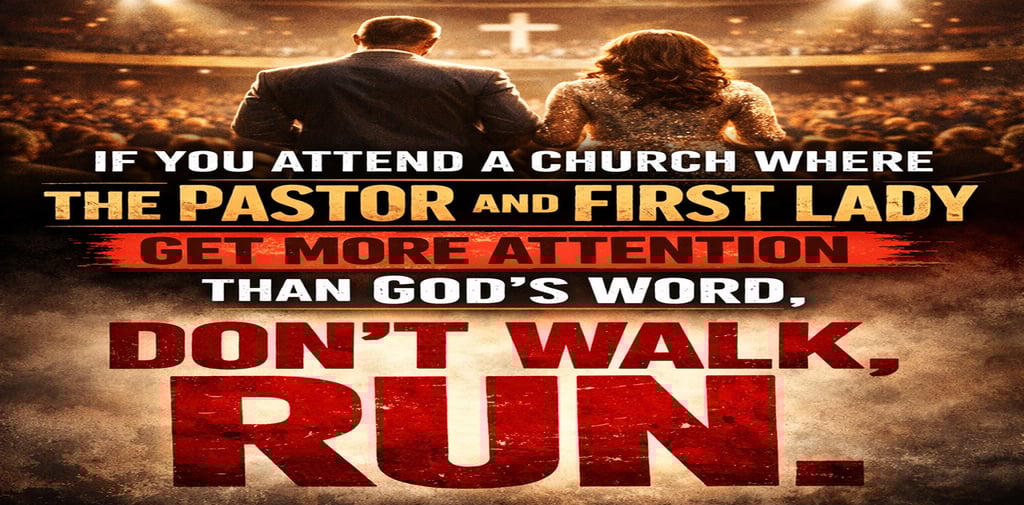
If the pastor and first lady receive more attention than God’s Word, the church is already in danger.
And if you stay long enough, you will be in danger too.
This is not about jealousy, bitterness, or church hurt.
This is about biblical order, spiritual authority, and the integrity of the Gospel.
1. When the Church Becomes a Stage Instead of an Altar
An altar is a place of surrender.
A stage is a place of performance.
When you walk into a church and immediately sense that everything revolves around a couple—their style, their charisma, their marriage, their lifestyle—you are not stepping into a house of prayer. You are entering a carefully curated ecosystem.
In these environments:
The Word is shortened to protect the vibe
Correction is avoided to preserve attendance
Scripture is selectively used to affirm leadership, not confront sin
The congregation exists to serve the vision rather than be formed into Christlikeness
The pastor becomes the brand.
The first lady becomes a symbol.
And Jesus becomes… background décor.
This is not accidental. It is systemic.
2. The Rise of “First Family” Culture
Nowhere in Scripture will you find a doctrine of the First Family of the Church.
You will find:
Shepherds accountable to God
Elders governing in plurality
Leaders warned not to domineer
Wives called to godliness, not visibility
Yet in many modern churches, especially within Black church culture, the pastor’s family is elevated into a royal class—untouchable, unquestionable, and uncorrectable.
This culture has been on full display in widely discussed churches such as New Birth Missionary Baptist Church, Relentless Church, and The Potter’s House—not because these churches are uniquely evil, but because they are highly visible representations of a larger pattern.
When leadership becomes celebrity, the church becomes fragile.
3. When Charisma Replaces Character
Charisma is not holiness.
Giftedness is not maturity.
Anointing is not approval.
Scripture warns us repeatedly that leaders can prophesy, preach, and perform miracles while still being deeply compromised. Jesus Himself said many will say “Lord, Lord”—and still be rejected.
We have watched, in real time, the unraveling of ministries where:
Moral failure was hidden behind spiritual language
Accountability was delayed until exposure forced it
Congregations were asked to “pray and move on” without truth
The public discussions surrounding leaders like John Gray and Tony Evans did not emerge because people hate the church. They emerged because the church failed to discipline itself.
When leaders are insulated by fame, restoration becomes performative rather than repentant.
4. The Role of the First Lady: Helpmeet or Highlight?
The Bible honors women deeply.
But it never assigns them the role of co-pastor by marriage.
Yet many churches subtly (or overtly) pressure the first lady to:
Be visible at all times
Preach without calling
Perform spiritual leadership without theological grounding
Serve as an emotional buffer between pastor and people
This creates impossible expectations and spiritual confusion.
In some churches, the first lady becomes:
A gatekeeper of access
A brand ambassador
An untouchable figure
And in the worst cases, she is forced to defend sin, silence victims, or maintain appearances at the expense of truth.
The very public scrutiny around couples like pastors Jamal and Karri Bryant, Wayne Chaney and Myesha Chaney again reflects not gossip—but structural dysfunction.
5. The Cost to the Congregation
When leadership is elevated beyond accountability, the congregation pays the price.
People experience:
Spiritual disillusionment
Confusion about God’s character
Shame for asking hard questions
Pressure to protect leaders instead of pursue truth
Many leave the church not because they hate God—but because they were spiritually manipulated, gaslit, or spiritually neglected.
Others stay but grow numb.
And some internalize the dysfunction, believing this is what Christianity looks like.
It is not.
6. Why People Stay (Even When They Know Better)
People stay because:
They’ve built community there
They fear being labeled rebellious
They are told leaving equals disobedience
They confuse loyalty with faithfulness
But loyalty to people is not loyalty to God.
Jesus never told His disciples to protect corrupt systems. He told them to follow Him—even when it meant leaving familiar structures.
7. Biblical Red Flags You Should Not Ignore
Run if:
Scripture is consistently shallow or selectively applied
Leadership cannot be questioned
Image matters more than integrity
Victims are silenced “for the sake of the church”
The Word serves the leaders instead of forming the people
Run if:
The sermon always circles back to honoring the pastor
The first lady is treated as spiritually superior by default
Correction is framed as “touching God’s anointed”
These are not minor issues.
They are spiritual warning signs.
8. God Is Shaking Systems, Not Just Individuals
What we are witnessing right now is not random.
God is exposing:
Celebrity Christianity
Performance-based faith
Power without accountability
Churches built on personality instead of truth
Judgment begins in the house of God—not to destroy it, but to purify it.
And those who refuse correction will eventually face collapse.
9. Leaving Is Not Apostasy
Let me say this clearly:
Leaving an unhealthy church is not rebellion.
It is often obedience.
Jesus is not confined to a building.
Your faith does not live or die by a pulpit.
Sometimes God calls people out before the collapse—not after.
10. Don’t Walk. Run. And Heal.
If you are in a church where:
The Word is secondary
Leaders are elevated beyond Scripture
Truth is sacrificed for image
Don’t walk.
Run.
And then heal.
Heal your discernment.
Heal your understanding of authority.
Heal your trust in God’s Word.
Because the Church belongs to Christ—not to pastors, not to first ladies, and not to brands.
And God will have His Church back.
Final Word
This is not an attack.
It is a warning.
The Gospel does not need celebrities.
It needs truth.
And wherever the Word of God is eclipsed by personalities, God will eventually remove the lampstand.
Choose wisely where you sit.
Your soul depends on it.