New Arrival!! Check Out Our Store To Order Your Copy of "Rest, Revive, Reset Now!
The Fake Gospel According To Oprah Winfrey and GPL 1's
GLP-1 drugs aren’t a cure. This faith-informed Op-Ed confronts health misinformation and calls for true healing to refute "the gospel according to Oprah Winfrey and GPL 1's," is not the gospel people need, they need to tap into the source of their pain and inflammation.
Dr. Makeda Ansah - Retired Nurse and The Soul Revivalist
1/16/20268 min read
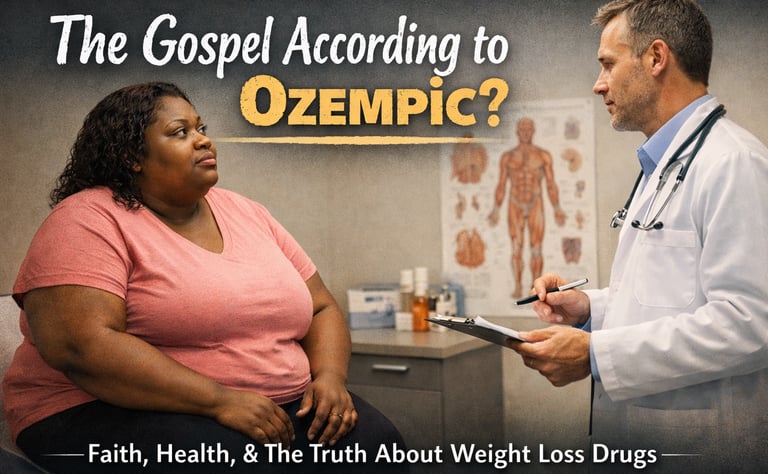
The Gospel According to Oprah and GLP 1’s?
Why Faith, Medicine, and Truth Demand We Stop Calling Band-Aids “Healing”
By Dr. Makeda Ansah, D.Min., Retired Nurse & Minister of the Gospel
Introduction: When the World Calls Appetite Control “Salvation”
We are living in an age where weight loss has become a moral virtue, thinness is marketed as holiness, and pharmaceutical appetite suppression is being heralded as enlightenment. As a retired nurse and ordained minister, I am deeply troubled—not only by the medical misinformation circulating under the banner of “health,” but by the spiritual deception masquerading as compassion.
Recently, prominent thought leaders have publicly championed injectable weight-loss drugs—particularly GLP-1 receptor agonists—as a revolutionary solution to obesity. These endorsements are framed as “freedom,” “liberation,” and even “self-care.” Yet what is being sold is not healing. It is management without repentance, appetite suppression without transformation, and profit without accountability.
I am especially disappointed when voices with decades of cultural authority—such as Oprah Winfrey—lend moral credibility to a narrative that reduces the human body to a malfunctioning machine and the human soul to a non-factor. When such voices promote pharmaceutical shortcuts without addressing the root causes of disease, they unintentionally participate in a system that profits from sickness rather than cultivating wholeness. What people like Oprah Winfrey, Serena Williams, and many other celebrities who have crowded this market of “easy solutions” to a stressful life often fail to acknowledge is that the hustle and machinery of Hollywood and enterprise culture do not merely exhaust the body—they deplete and ensnare the soul. Many of these figures are themselves under immense stress, driven by personal insecurities, unchecked ambition, and an unbalanced view of life.
Unfortunately, it does not stop there. They go on to influence and infiltrate the minds of those who look up to them, often exploiting vulnerabilities and unhealed wounds for profit or relevance. In doing so, they function less as guides and more as grifters—and at times, predators—within a system that feeds on desperation rather than healing. May God help us all to discern truth from deception.
Further, Scripture warns us:
“For the time will come when people will not endure sound doctrine, but according to their own desires, because they have itching ears, they will heap up for themselves teachers who will tell them what they want to hear rather than what they need to hear (2 Timothy 4:3, NKJV)
And what we want to hear in this age of exhaustion, trauma, and unaddressed grief is simple: “You don’t need to change. You just need a prescription.”
But the Gospel—and good medicine—have never worked that way.
Obesity Is Not a Moral Failure—But Neither Is It a Mystery
Let me be clear: obesity is not a sin, and people living in larger bodies are not morally inferior, lazy, or lacking discipline. That narrative has caused immeasurable harm and must be rejected outright.
However, obesity is also not a random accident—nor is it best understood as a cosmetic inconvenience requiring pharmaceutical correction.
From decades of nursing practice and pastoral care, I can say with confidence: obesity is most often an inflammatory response—a signal from the body that something deeper is wrong.
Inflammation does not appear in isolation. It is the body’s alarm system responding to:
Chronic stress
Unresolved trauma
Hormonal dysregulation
Sleep deprivation
Emotional eating rooted in abandonment or grief
Toxic relationships and unsafe environments
Poverty, food deserts, and systemic neglect
Long-term cortisol elevation
Spiritual disconnection and lack of rest
When we treat obesity without addressing these drivers, we are not practicing medicine—we are practicing symptom suppression.
Scripture affirms this integrated understanding of the human person:
“May your whole spirit, soul, and body be preserved blameless.”
(1 Thessalonians 5:23)
God does not divide us into silos. Neither should healthcare.
GLP-1 Drugs: What They Do—and What They Don’t
GLP-1 receptor agonists were originally developed to manage Type 2 diabetes, not to serve as mass-market weight-loss solutions. Their mechanism is straightforward: they slow gastric emptying, suppress appetite, and alter hunger signaling in the brain.
What they do not do is:
Heal trauma
Regulate stress hormones
Restore metabolic flexibility long-term
Teach sustainable lifestyle practices
Address emotional dependency on food
Repair gut health damaged by years of inflammation
Heal the nervous system
Reconcile a person to their body
As a nurse, I am also obligated to say plainly what is often minimized in celebrity conversations:
These drugs are not benign.
Documented side effects include:
Severe nausea and vomiting
Gastroparesis (delayed stomach emptying)
Gallbladder disease
Pancreatitis
Muscle mass loss
Nutritional deficiencies
Rebound weight gain after discontinuation
Psychological distress around food aversion
And yet, these risks are frequently downplayed—especially when the spokesperson has private healthcare, elite monitoring, and financial insulation from long-term consequences.
The masses do not.
A Band-Aid Is Not Healing—It Is Delay
In medicine, a band-aid has a purpose: temporary protection while healing occurs underneath.
But when a band-aid is applied without addressing the wound, it becomes deception.
Scripture uses similar language when confronting superficial solutions:
“They dress the wound of my people as though it were not serious. ‘Peace, peace,’ they say, when there is no peace.”
(Jeremiah 6:14)
GLP-1 drugs are being sold as peace—without truth.
They offer appetite control without appetite discernment.
They offer weight loss without weight meaning.
They offer relief without repentance, renewal, or rest.
And when the injections stop, many people find the weight returns—often accompanied by shame, confusion, and a deeper sense of failure.
That is not healing. That is delay followed by despair.
The Body Is Not the Enemy—It Is the Messenger
Modern wellness culture treats the body as a problem to be conquered. Scripture treats the body as a temple.
“Do you not know that your body is the temple of the Holy Spirit… therefore glorify God in your body.”
(1 Corinthians 6:19–20)
A temple is not disposable.
A temple is not optimized for profit.
A temple is stewarded with reverence.
When the body gains weight, it is often protecting itself—storing energy in response to perceived danger, scarcity, or chronic stress. Weight gain can be a form of survival, not failure.
Instead of asking, “How do I make my body smaller?”
We should be asking, “Why does my body not feel safe?”
That question leads to healing.
The injection bypasses it.
Trauma, Stress, and the Theology of Cortisol
Chronic stress is not just emotional—it is biochemical. Long-term cortisol elevation alters insulin sensitivity, fat storage, sleep cycles, and hunger signaling.
In pastoral care, I have witnessed again and again that people who carry unresolved grief, betrayal, abuse, or spiritual disillusionment often carry it in their bodies.
Jesus never treated symptoms without addressing source.
When He healed, He often asked questions first.
When He restored, He named wounds.
When He transformed lives, He called people into metanoia—a changed mind.
“Be transformed by the renewing of your mind.”
(Romans 12:2)
No injection can accomplish that.
When Wellness Becomes a Marketplace
There is a dangerous convergence happening between celebrity culture, pharmaceutical marketing, and spiritual emptiness.
Influencers sell vulnerability.
Corporations sell solutions.
People buy hope.
This is not new. Scripture names it clearly:
“For the love of money is a root of all kinds of evil.”
(1 Timothy 6:10)
When influential voices promote medical interventions without fully grappling with ethics, access, long-term consequences, and spiritual implications, they risk becoming unwitting grifters in a broken system—even if their intentions feel sincere.
The result is a public that is medicated, not healed. Managed, not restored. Smaller, perhaps—but not whole.
The Real Prescription: Repentance, Rest, and Reordering
Biblical health is not aesthetic. It is relational.
It involves:
Repentance: turning away from self-neglect, overwork, and disordered attachments
Rest: honoring Sabbath in a culture addicted to productivity
Reordering: placing God—not food, not control, not thinness—at the center
“Seek first the Kingdom of God and His righteousness, and all these things shall be added to you.”
(Matthew 6:33)
Healing begins when people are taught to:
Eat with gratitude, not guilt
Move their bodies as worship, not punishment
Address trauma with truth, not denial
Leave toxic environments, even when familiar
Stop medicating wounds that require mourning
Value obedience over optimization
This is slower work.
Harder work.
Sacred work.
A Call to Discernment—for the Church and the Public
The Church must stop outsourcing health discipleship to celebrities and corporations.
Pastors must speak about stress, food, rest, trauma, and embodiment—not just sin and salvation in abstraction.
Healthcare professionals must stop pretending that pharmaceutical convenience equals compassion.
And the public must learn discernment again.
“Test all things; hold fast what is good.”
(1 Thessalonians 5:21)
Not everything marketed as “health” leads to life.
Conclusion: Choose Truth Over Convenience—And Healing Over Hype
GLP-1 drugs may have a place in limited, carefully monitored clinical contexts. But they are not a moral awakening, not a spiritual solution, and not the answer to a society sick from stress, greed, trauma, and disconnection from God.
We do not need another injection.
We need a changed mind.
A healed heart.
A restored nervous system.
A reverence for the body as God’s dwelling place.
Anything less is a band-aid sold as a miracle.
This moment demands more from us than passive consumption and emotional agreement. It demands discernment, courage, and responsibility.
We cannot continue to call chemical appetite suppression “healing” while ignoring the emotional, spiritual, relational, and societal wounds that drive disordered eating and metabolic dysfunction in the first place. We cannot applaud celebrity confessions while refusing to interrogate the systems that profit from our exhaustion. And we cannot claim to follow Christ while outsourcing stewardship of the body—God’s temple—to market forces that do not know Him.
Scripture does not permit us to be naïve consumers.
“The prudent see danger and take refuge, but the simple keep going and pay the penalty.”
(Proverbs 22:3)
The danger is not medication itself. The danger is misplaced trust—trusting in pharmaceuticals to do the work of repentance, in injections to do the work of renewal, and in influencers to do the work of shepherds.
This is a call to slow down in a culture addicted to quick fixes.
A call to ask better questions before accepting medical trends as moral progress.
A call to reclaim the theology of the body from both diet culture and pharmaceutical marketing.
A Call to the Public
If you are considering—or already using—weight-loss medications, pause and ask:
What stress, grief, or trauma has my body been carrying?
What habits have been formed in survival mode?
What relationships or environments are keeping my nervous system in constant fight-or-flight?
What does my body need beyond weight loss—safety, rest, truth, or boundaries?
Do not silence your body. Listen to it.
Do not rush healing. Participate in it.
A Call to Healthcare Professionals
If you are a clinician, nurse, or health educator, you are not merely a technician—you are a steward of trust.
Refuse to reduce patients to numbers, BMI charts, or prescription protocols.
Advocate for trauma-informed care.
Speak honestly about risks, limitations, and long-term consequences.
Resist the pressure to medicalize what requires time, teaching, and transformation.
Remember:
“To whom much is given, much will be required.”
(Luke 12:48)
A Call to the Church
The Church must reclaim its role in discipling the whole person.
We must teach congregants how stress, unforgiveness, overwork, fear, and unresolved trauma live in the body. We must preach Sabbath again—not as a suggestion, but as obedience. We must create spaces where healing is not rushed and testimonies are not transactional.
The Church must stop being silent while the marketplace disciples the people of God.
“My people are destroyed for lack of knowledge.”
(Hosea 4:6)
What True Healing Looks Like
The invitation before us is not to be thinner—it is to be whole.
Whole in mind.
Whole in body.
Whole in spirit.
This kind of healing cannot be injected. It must be cultivated—through truth, repentance, rest, community, and submission to God’s design.
The Gospel has never promised convenience.
It has always promised transformation.
So let us choose discernment over hype.
Stewardship over shortcuts.
Healing over hiding.
And let us remember: anything that bypasses the heart will eventually betray the body.
Watch Below as Oprah Winfrey and a Doctor Tries To Convince the Audience of 'The View," to Put Yet Another Bandaid On Their Problems and Possibly Cause More Harm Than Good.
